The level keeps dropping
You refill it repeatedly even when use has not increased and there has been no unusual splash-out.

Water-loss diagnosis · Tenerife South
If you keep topping up the pool, the useful question is not just whether it leaks, but where the water is going. We inspect the pool systematically before recommending a repair.
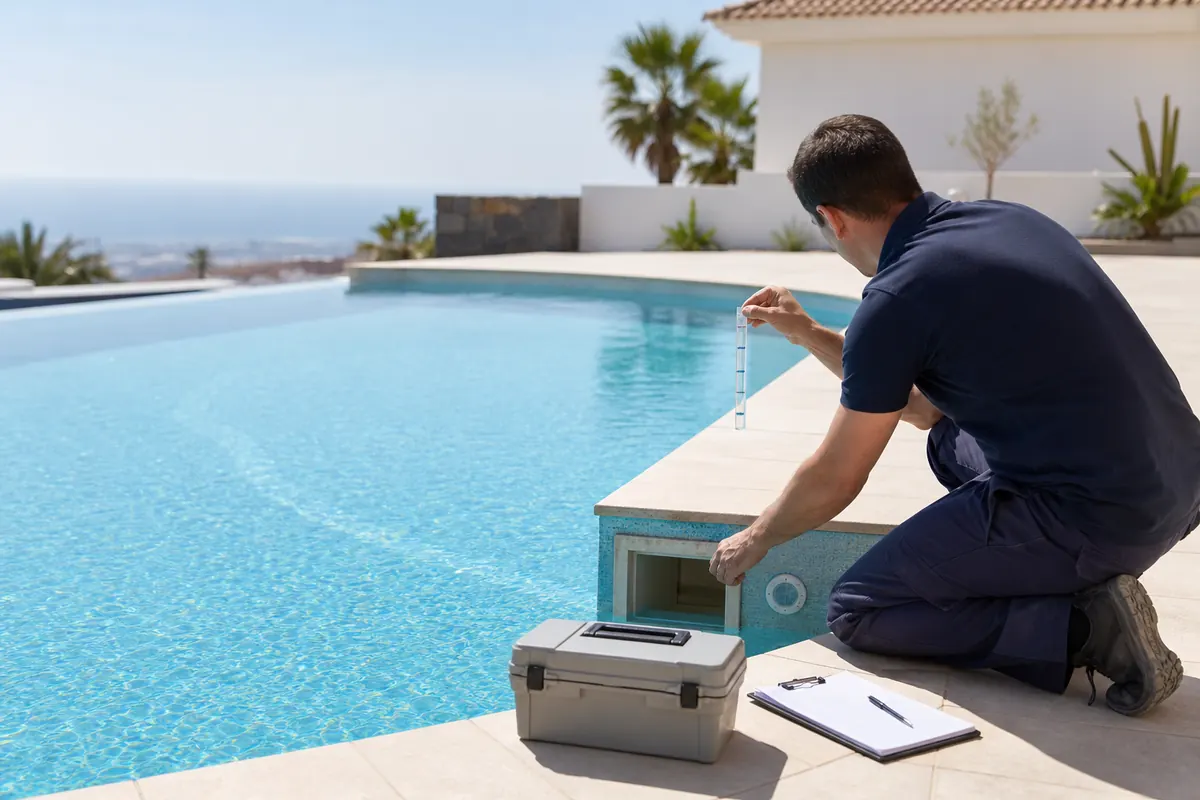
First diagnosethen decide how to repair
Pool + equipmentnot just the visible surface
EN · ESAdeje and Tenerife South
Clues, not proof
One symptom on its own does not confirm a leak. Several signs together, or a measured difference against evaporation, justify a proper diagnosis.
You refill it repeatedly even when use has not increased and there has been no unusual splash-out.
An auto-fill can hide the loss because it restores the level before you notice it. Water consumption becomes the clue.
Persistent dampness near the pool or equipment can be relevant, although underground water does not always surface nearby.
Air in the suction side or repeated priming problems can point to a hydraulic issue, but the equipment must also be checked.
If the loss slows around a skimmer, return, light or another fitting, that level can help focus the inspection.
Constant fresh-water top-ups dilute treatment. Needing more chemicals is a consequence to investigate, not proof by itself.
A useful first check
Sun, wind, humidity, water temperature and use all change evaporation. That is why a fixed number of millimetres per day is less useful than comparing the pool with a bucket exposed to the same weather.
This comparison follows the principle in the US EPA outdoor pool water-efficiency guide (PDF). It confirms abnormal loss; it does not locate the fault.
A pool is a complete system
The water may leave through the structure, a fitting, the equipment area or an underground circuit. The same symptom can therefore have very different repairs.
Cracks, joints, liner damage, grout deterioration or a weak point around a structural movement.
Skimmer throat, returns, suction points, light housings, main drain connections and their seals.
Pump unions, filter connections, valves, dosing equipment, heater connections or the waste/backwash route.
Suction and return circuits can lose water underground without leaving an obvious wet patch at the break.
Overflow channels, balance tanks and level controls can send water away even when the pool shell is sound.
A faulty level control may mask a pool leak or itself cause water to run continuously towards an overflow.
A diagnosis with order
The exact checks depend on the pool. The purpose is to separate possible causes before any disruptive repair is proposed.
We ask when the loss started, how much the level drops, whether it changes with the pump, and what work or faults came before it.
We review the waterline, accessible fittings, equipment pad, valves and obvious paths that could explain the loss.
Targeted checks help determine whether the likely source is the pool body, an accessible component or a plumbing circuit.
You receive a clear conclusion and, where appropriate, a repair proposal focused on the affected area rather than guesswork.
When a pipe is suspected
Leak detection looks at the whole pool. Pressure testing isolates plumbing circuits to check which line holds and which one loses pressure. It is one diagnostic method, not a synonym for the complete service.
Local service
We assess private pools, rental villas and community pools in Adeje, Costa Adeje, El Madroñal, Roque del Conde, Fañabé, Callao Salvaje, Abama, Arona, Playa de las Américas, Los Cristianos, Chayofa, San Miguel and Golf del Sur.
Send the location and the behaviour of the water level first. This helps us decide whether the initial visit should focus on the pool body, equipment or plumbing.
Send the details through the contact pageBefore arranging a visit
Clear answers about evaporation, diagnosis and what happens after the source is narrowed down.
A controlled bucket test compares the drop in the pool with water exposed to the same weather in a bucket. If the pool level falls further, there may be a leak. Turn off automatic filling and avoid rain or very strong wind during the comparison.
Not in every case. Many initial checks can be made with the pool at its normal level. Whether water must be lowered depends on the suspected area, access and the test required.
The diagnostic process separates likely causes and narrows the affected area. A pressure test can show which plumbing circuit is losing pressure, although a further location step may be needed to identify the exact underground point.
Diagnosis and repair are separate decisions. Once the likely source is known, we explain the result and prepare the appropriate repair proposal instead of opening or replacing parts blindly.
It depends on the pool size, the number of circuits, access to the equipment and how the water behaves. We review the case first and tell you what should be checked before arranging the visit.
Send the location, approximate pool size, how much the level drops in 24 hours, whether automatic filling is on, whether the loss changes with the pump running, and clear photos of the pool and equipment area.
Water-loss assessment
Include how many centimetres the pool loses, over how many days, and whether it changes with the pump on or off. We will help choose the right first check.
Pool leak detection
You can also use the full contact page.