Measure the water surface
Use the longest inside length and width. For a circle, measure the diameter through its centre.

Free pool calculator
Find out how many litres your swimming pool holds, even when it is round, oval, L-shaped or irregular. Use the result to plan water care, filtration or a clearer quote.
Measure to the normal water line, not the top edge. Use metres; decimals such as 1.4 are accepted.
You only need a tape measure and the normal water level. Accurate measurements matter more than complicated formulas.
Use the longest inside length and width. For a circle, measure the diameter through its centre.
Measure from the water line to the floor at the shallow and deep ends. Their average represents a sloping floor.
For the best irregular-pool estimate, split the plan into rectangles, circles or ovals, calculate each section and add them.
These worked examples show which formula is being used. Load any one into the calculator and adapt the measurements to your pool.
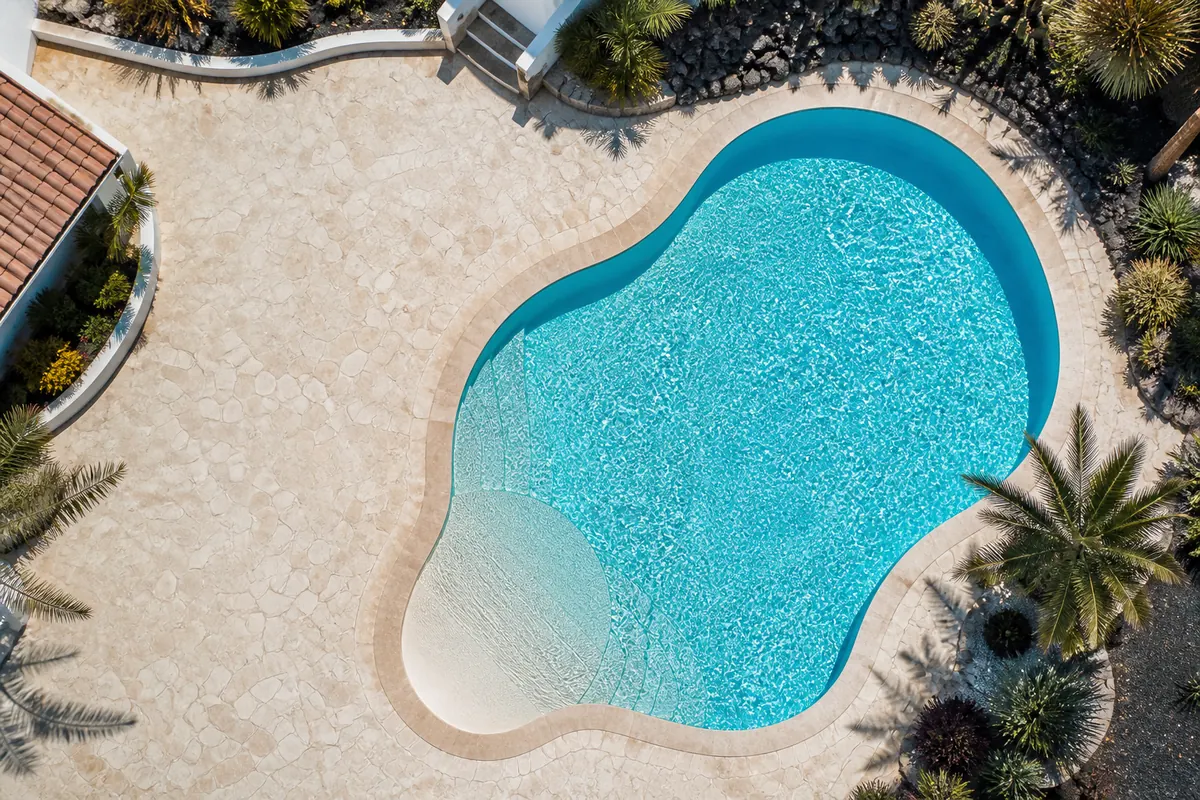
Visual shape references created for this guide. They explain the geometry and do not represent completed Tenerife Pools projects.
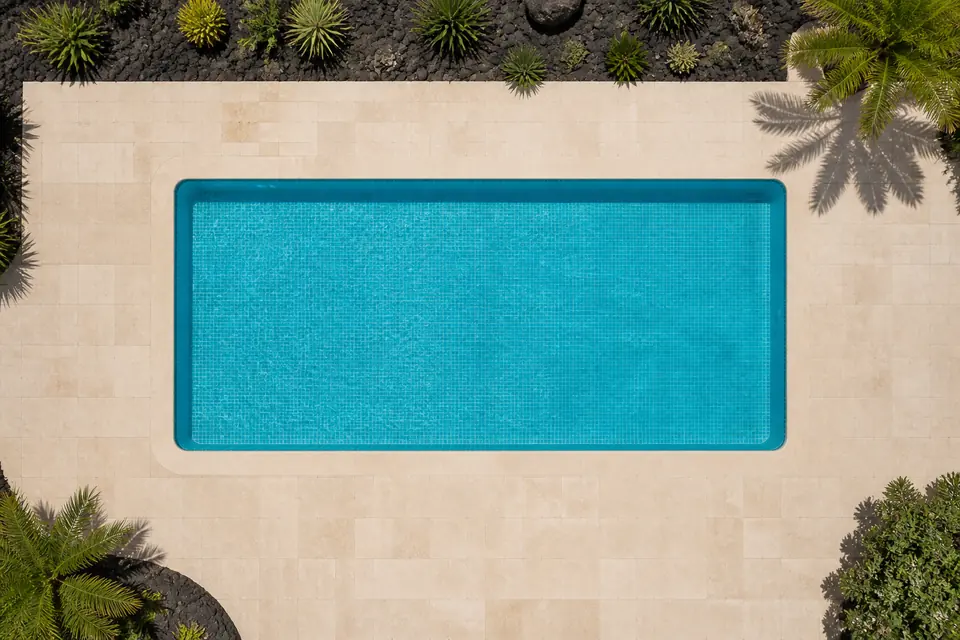
8 × 4 m, with 1.2 m and 1.8 m depths.
8 × 4 × 1.5 × 1,00048,000 litres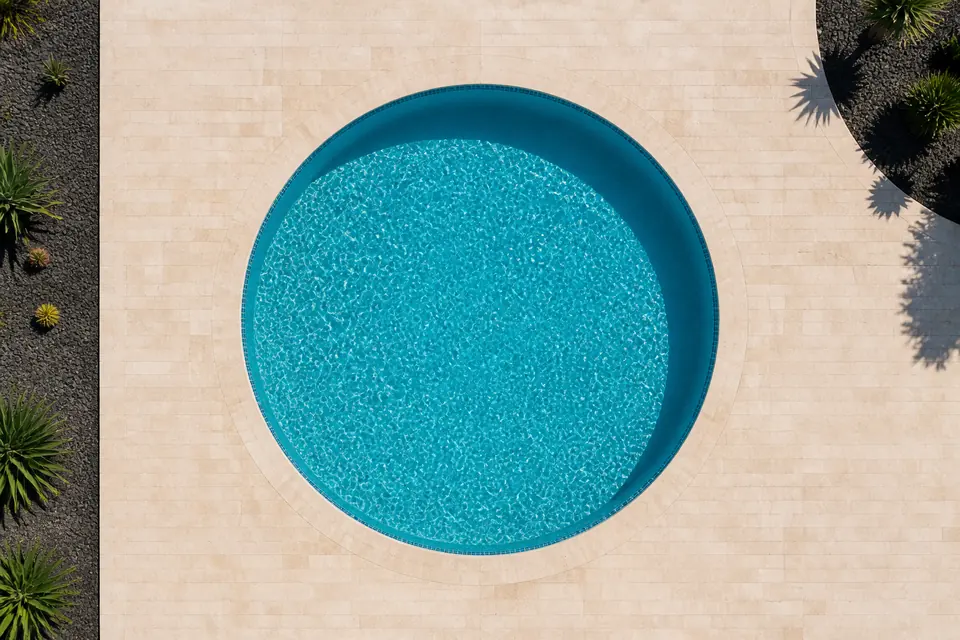
4 m diameter, with an average depth of 1.4 m.
π × 2² × 1.4 × 1,000≈ 17,600 litres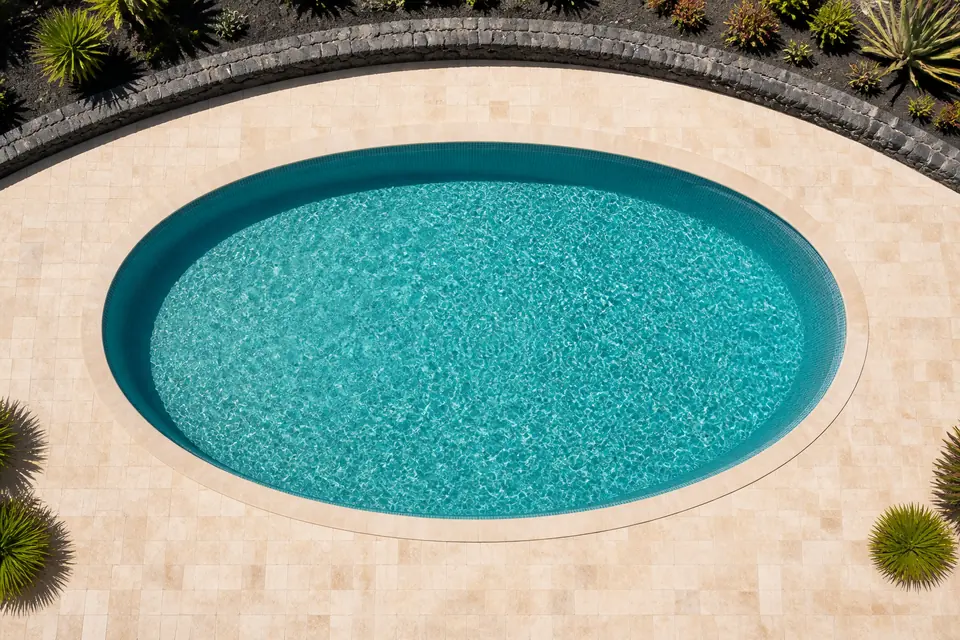
8 × 4 m, with an average depth of 1.5 m.
π ÷ 4 × 8 × 4 × 1.5 × 1,000≈ 37,700 litres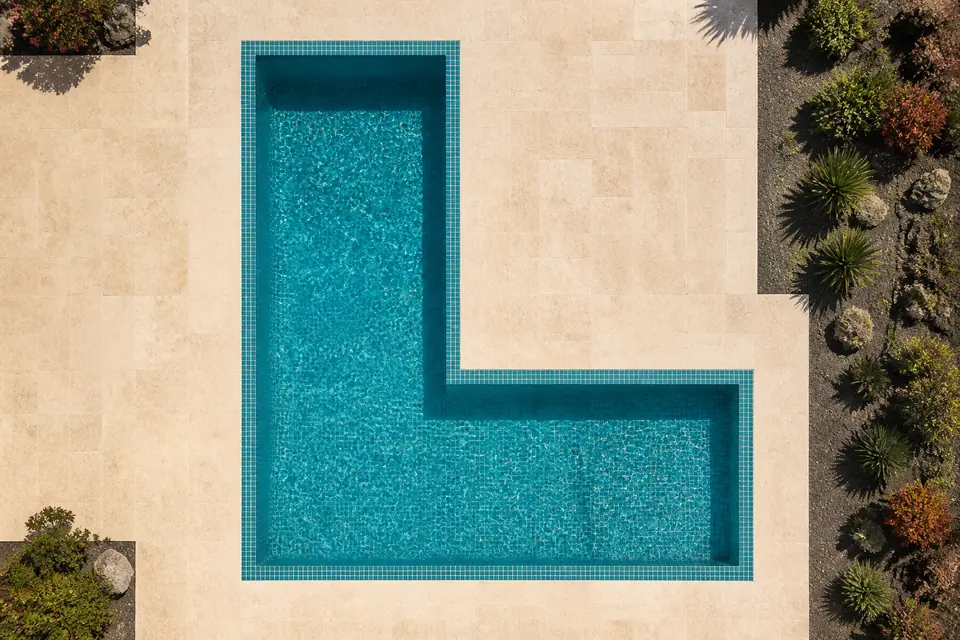
Two sections of 6 × 3 m and 3 × 2 m, average depth 1.5 m.
(18 + 6) × 1.5 × 1,00036,000 litres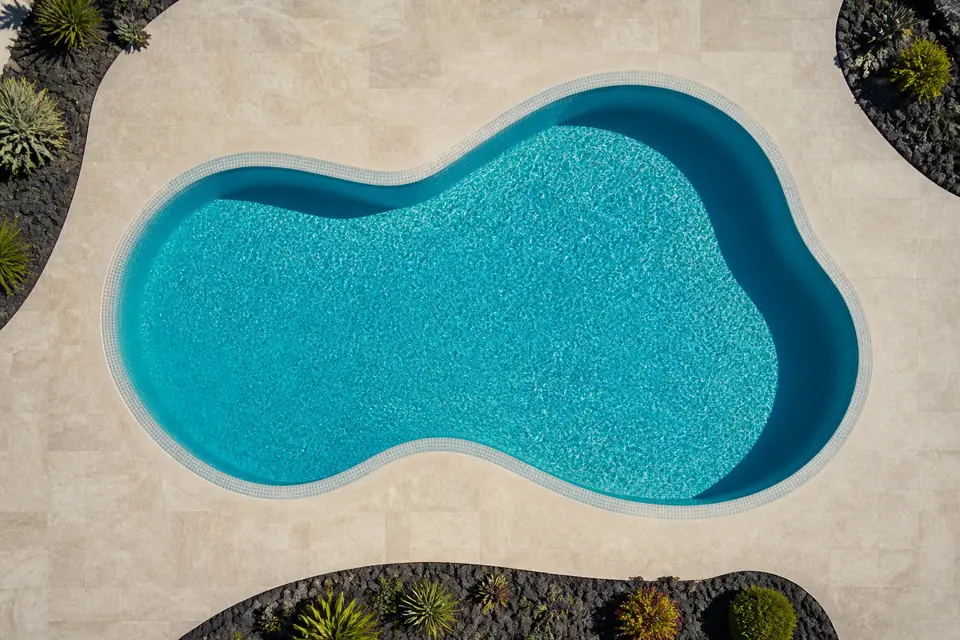
8 × 5 m boundary, 85% water coverage, average depth 1.4 m.
8 × 5 × 0.85 × 1.4 × 1,000≈ 47,600 litresThe calculator gives a practical capacity, not laboratory precision. These references explain where the number comes from and when to refine it.
Quick reference
| Inside size | Average depth | Approx. volume |
|---|---|---|
| 6 × 3 m | 1.4 m | 25,200 L |
| 7 × 3.5 m | 1.4 m | 34,300 L |
| 8 × 4 m | 1.5 m | 48,000 L |
| 10 × 5 m | 1.5 m | 75,000 L |
These values assume straight walls and do not subtract large steps or benches.
Sloping floors
Add the shallow depth and the deep depth, then divide by two. A pool measuring 1.2 m at one end and 1.8 m at the other has an estimated average depth of 1.5 m.
(1.2 + 1.8) ÷ 2 = 1.5 mBuilt-in features
The quick result includes the whole outer shape, so large solid features make the real water capacity slightly lower. For routine care, the estimate is normally enough; for technical sizing, measure the displaced section separately.
Complex plans
For a better estimate, draw the pool from above, divide it into rectangles, circles or ovals, calculate each part with its own average depth and add the results. Use the shape factor only when detailed measurements are not practical.
Use the surface, not the total capacity
To estimate water loss, multiply the pool surface area by the drop in metres and by 1,000. Depth is not used because only the missing top layer is being measured.
Rain, splash-out, backwashing and automatic filling can change the reading. Compare the level under controlled conditions before assuming there is a leak.
Use the calculated volume when you contact us. It helps us understand the pool before a visit and give more relevant guidance.
Water testing, cleaning and regular care tailored to the real size and use of your pool.
→ 02 · EQUIPMENTCheck whether filtration, circulation or heating equipment suits the pool volume.
→ 03 · PROJECTSPlan a new pool or renovation with clear dimensions, systems and a free personalised quote.
→ 04 · WATER LOSSSeparate evaporation from an actual loss and investigate the shell, fittings, equipment and plumbing.
→ 05 · PIPEWORKCheck individual suction and return lines before planning a targeted underground repair.
→Short answers to the measurements and formulas people most often search for.
Add the shallow-end depth to the deep-end depth and divide by two. If the floor is flat, enter the same depth in both fields.
Multiply pi by the radius squared and by the average depth, then multiply cubic metres by 1,000. The calculator applies this formula automatically from the diameter.
It is an approximation based on the longest dimensions and a shape factor. For better accuracy, divide the pool into simple rectangles and circles, calculate each section and add the results.
The quick calculation does not subtract the water displaced by steps, benches or large internal features, so the real capacity may be slightly lower.
Volume helps with water treatment, product quantities, filtration flow, heating estimates and clearer maintenance or repair quotes.
One cubic metre of water equals 1,000 litres. A 48 cubic metre pool therefore contains approximately 48,000 litres.
Multiply the water surface area in square metres by 10. An 8 by 4 metre rectangular pool has 32 square metres of surface, so a one centimetre drop represents approximately 320 litres, before allowing for rain, splash-out or refilling.
The estimate is a useful starting point, but always follow the product label and measure the current water values. For concentrated products or a problem pool, confirm the dose with a pool professional.
Tell us the result and what is happening with your pool. Advice and quotes are free and without obligation.