The circuit is less likely to be the source
A stable reading helps rule out that line and redirects the diagnosis towards other pipes, fittings, equipment or the pool structure.

Plumbing diagnosis · Tenerife South
When a pool loses water and buried plumbing is suspected, each hydraulic circuit can be checked separately. The result tells us which line deserves attention before any repair is planned.
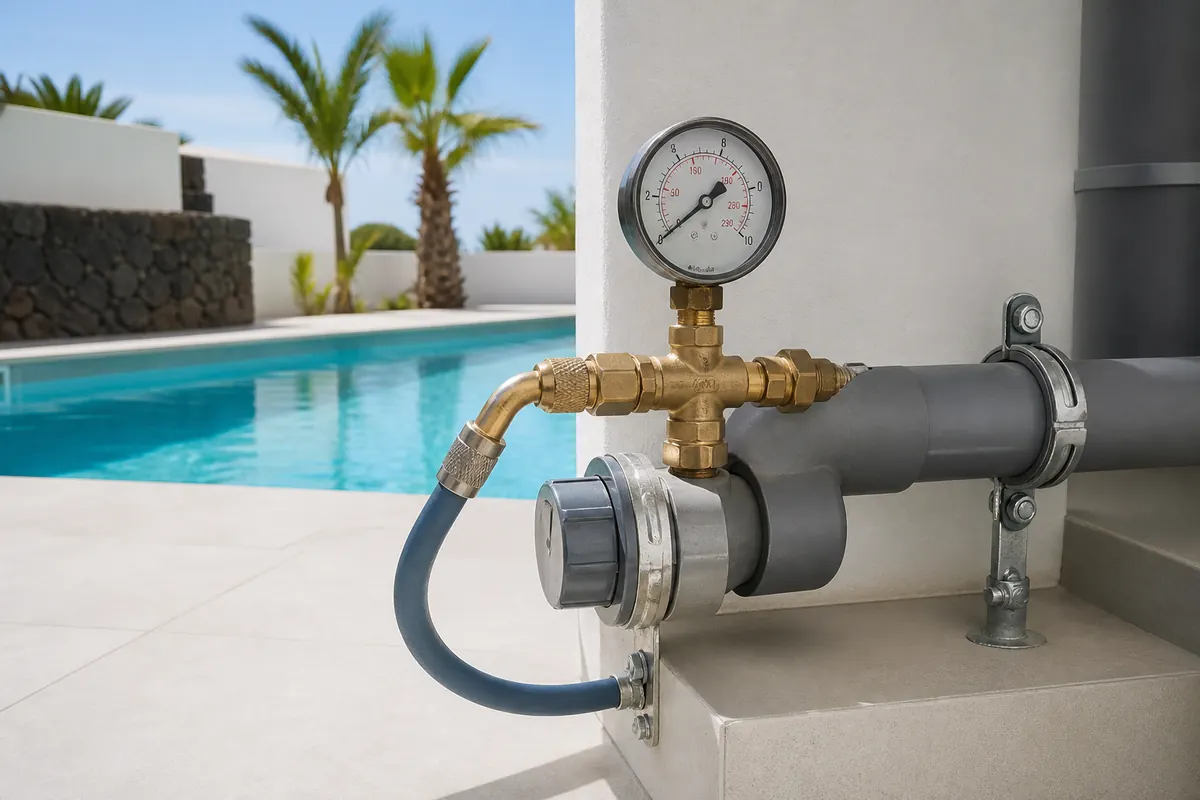
One line at a timesuction and return circuits
Measured resultholds pressure or needs investigation
Before openingreduce unnecessary work
A specific diagnostic test
A pressure test does not assess every possible pool leak. It answers whether an isolated pipe circuit is able to maintain a controlled pressure during the observation.
A stable reading helps rule out that line and redirects the diagnosis towards other pipes, fittings, equipment or the pool structure.
A loss points to that line or its connections. It narrows the search, but it may not yet reveal the exact underground break location.
Map before testing
Not every pool has the same layout. We identify the actual lines and accessible fittings first, then define which circuits can be isolated safely.
The line that carries surface water from one or more skimmers towards the pump.
The bottom suction circuit, where it exists and its fittings allow an appropriate test.
A dedicated suction point for manual cleaning or a hydraulic pool cleaner.
The pipework that sends filtered water back to the pool through one or more return fittings.
Dedicated lines for cascades, jets, spa areas or other features when they are separate and accessible.
Heating bypasses, balance-tank lines or special hydraulic routes are reviewed case by case.
When the question is in the pipework
It is most valuable when the diagnosis already points towards plumbing, or when several buried lines must be separated before choosing where to intervene.
Testing helps compare plumbing circuits rather than assuming that every loss comes from the structure.
A different behaviour with circulation on or off can make suction or return pipework more relevant to the diagnosis.
Recurring priming problems, an earlier repair or a known route under the deck may justify checking that line independently.
A measured result can focus the work and reduce the chance of lifting a surface where the affected line is not located.
Where appropriate, a controlled check can help verify the integrity of an accessible circuit before finishes hide it.
Testing them separately avoids treating all nearby circuits as faulty when only one may be losing pressure.
Controlled and circuit by circuit
We do not publish generic test pressures because materials, equipment and installations have different limits. The test is defined from the actual system.
We identify skimmers, returns, suction points, valves, equipment and any dedicated route that may form a separate circuit.
The circuit is separated from the pool and from equipment that should not form part of the pipe test.
The line is monitored to determine whether it maintains the test condition or shows a consistent loss.
The results show which lines can be set aside and which need a more precise location or repair proposal.
Two related services
Keeping the two jobs separate makes the result easier to understand and avoids promising that one test can diagnose the whole pool.
| Question | Pool leak detection | Pressure testing |
|---|---|---|
| Main purpose | Find why the complete pool is losing water. | Check whether a particular plumbing circuit holds pressure. |
| What it considers | Shell, fittings, equipment, overflow systems and pipework. | The isolated suction, return or dedicated line under test. |
| Typical result | A likely source or area and the next diagnostic or repair action. | A line that holds or a line that requires further investigation. |
| Does it locate an underground point? | It may require several methods depending on the cause. | Not always; it first identifies the affected circuit. |
If you are only seeing the water level fall and do not yet know whether the pipework is involved, start with complete pool leak detection.
Professional safety
Stored pressure and trapped air can make components hazardous. Pumps, filters, heaters and accessories also have manufacturer-specific limits and may need to be excluded from the pipe test.
Manufacturer documentation itself distinguishes pressure testing of the piping system from testing pool equipment. See, for example, the safety section in this Jandy/Zodiac installation manual (PDF).
For that reason we explain what the service measures, but we do not provide a generic pressure value or trial-and-error procedure.
Local service
We review pool plumbing in Adeje, Costa Adeje, El Madroñal, Roque del Conde, Fañabé, Callao Salvaje, Abama, Arona, Playa de las Américas, Los Cristianos, Chayofa, San Miguel and Golf del Sur.
Before quoting, send photos of the pool fittings, the equipment area and any valve labels, together with the approximate pool size and the water-loss pattern.
Send the installation detailsBefore the test
What the result means, which lines may be tested and why this is a professional procedure.
A pool plumbing circuit is isolated, subjected to a controlled test pressure and monitored to see whether it holds. A stable result helps rule that circuit out; a pressure loss indicates that the line or its test connections require further investigation.
Depending on the installation and access, separate circuits can include skimmer suction, main drain, vacuum or cleaner line, returns, water features and other dedicated hydraulic lines. We map the actual installation before deciding what can be tested.
No. Leak detection considers the complete pool, including the shell, fittings, equipment and plumbing. Pressure testing answers the narrower question of whether an isolated plumbing circuit maintains pressure.
Often a complete drain is not required, but the water level, access to fittings and test preparation depend on the design of the pool. We confirm the required conditions after reviewing the installation.
It identifies the circuit that does not hold pressure, which prevents guessing between several lines. It does not always reveal the exact underground point, so a further location step may be needed before opening the surface.
It is not a suitable trial-and-error task. Pressurised components can be hazardous, trapped air must be controlled and pumps, filters and other equipment have manufacturer limits. The system should be isolated and tested by someone who understands the installation.
Circuit-by-circuit diagnosis
Send the water-loss pattern and a photo of the equipment bay. We will tell you whether pressure testing is the right next step for your pool.
Pool pipe pressure testing
You can also use the full contact page.